
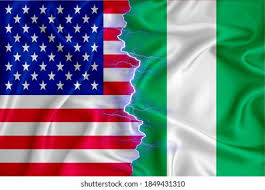
Nigeria–US Relations: A partnership at the crossroads of history, strategy, and opportunity

By Chris Uba
Nigeria and the United States share a long, complicated, and constantly evolving relationship—one shaped by geopolitics, security interests, trade, democracy, migration, and culture. Over the decades, the partnership has swung between periods of intense cooperation and moments of diplomatic frost. Yet the relationship endures, strengthened by mutual necessity and the recognition that both nations stand to gain from deeper engagement.
As global power shifts and Africa becomes an increasingly contested arena for influence—from China’s expanding footprint to Europe’s retreat and Russia’s opportunism—Nigeria’s significance grows. For the US, Nigeria is more than a large West African state; it is a demographic giant, a diplomatic heavyweight, and an economic hub with the potential to shape the continent’s future. For Nigeria, the US remains a key development partner, a security ally, and home to one of the most vibrant African diasporas.
Today, the Nigeria–US relationship is at an inflection point. The challenges are real, but so are the opportunities.
A Historical Partnership Forged by Shared Interests
Formal relations between Nigeria and the United States began shortly after Nigeria’s independence in 1960. During the Cold War, the US viewed Nigeria as a strategic counterweight to Soviet influence in Africa. Nigeria’s oil wealth, population, and role in regional diplomacy made it an indispensable partner. In return, Nigeria sought American support for nation-building, economic development, and military training.
However, the partnership was never linear. Military coups in Nigeria, human rights violations, and political instability created tensions. The execution of activist Ken Saro-Wiwa in 1995 brought relations to one of their lowest points, with the US imposing sanctions and harshly criticising the Abacha regime.
Democracy’s return in 1999 revived cooperation. President Olusegun Obasanjo’s administration rekindled ties as the US supported democratic reforms, anti-corruption efforts, and Nigeria’s peacekeeping missions across West Africa. American companies deepened investments in Nigeria’s oil and gas sector, turning the country into one of the largest African suppliers of crude to the US—until the shale revolution reshaped global energy flows.
Security: The Bedrock and the Battlefield
If one issue dominates Nigeria–US relations today, it is security. Nigeria’s struggle against Boko Haram, Islamic State West Africa Province (ISWAP), banditry, and kidnapping has compelled Abuja to seek deeper military cooperation with Washington.
Yet cooperation has not always been smooth. For years, the US was reluctant to sell certain categories of weapons to Nigeria due to human rights concerns. The 2014 refusal to supply Cobra attack helicopters generated significant controversy, coming at the height of the Boko Haram insurgency and after the abduction of the Chibok schoolgirls.
But in 2021, a shift occurred: Nigeria acquired 12 A-29 Super Tucano aircraft from the US—the largest US arms sale to sub-Saharan Africa at the time. This marked a new phase of trust-building between the two nations’ security establishments.
Today, the relationship includes:
Intelligence sharing
Counterterrorism training
Support for maritime security in the Gulf of Guinea
Cooperation on cybercrime and money laundering
Capacity building for the Nigerian military and police
Still, human rights concerns remain a sticking point. The US periodically raises alarms over excessive force by security agencies, civilian casualties, and the need for accountability. Nigeria, on its part, argues that terrorism is existential and requires robust support, not selective engagement.
The security relationship is therefore both a backbone and a battleground—powerful, but occasionally strained.
Trade and the Oil Factor: An Old Marriage with New Realities
Trade between Nigeria and the US has historically revolved around oil. By the early 2000s, Nigeria was one of America’s top crude suppliers. But the US shale oil boom dramatically altered the equation. US imports of Nigerian crude dropped to near zero, forcing Nigeria to diversify its export markets.
Still, trade remains significant. The US is a major importer of Nigerian agricultural products, textiles, and metals. Through the African Growth and Opportunity Act (AGOA), Nigerian exporters enjoy duty-free access to the US market—although Nigeria has not fully maximised the opportunity compared to smaller economies like Kenya or Ethiopia.
Meanwhile, American corporations—including Chevron, ExxonMobil, Microsoft, GE, Google, Pfizer, and Procter & Gamble—continue to operate in Nigeria. As Nigeria pushes to reform its business environment, attract foreign investment, and reposition itself as Africa’s digital hub, US companies may play an even greater role.
Yet concerns persist. Investors frequently cite Nigeria’s foreign exchange instability, regulatory unpredictability, and insecurity as major risks. For the relationship to flourish economically, Nigeria must strengthen institutions, enforce contracts, and stabilise the macroeconomic environment.
Democracy and Diplomacy: Shared Values, Uneven Practice
Over the years, the US has taken a keen interest in Nigerian elections, governance, and human rights. Washington sees Nigeria as a democratic bellwether for Africa. Free elections in Nigeria often set a positive trend for the region; flawed ones send the opposite signal.
US support in democracy-related areas includes:
Election monitoring
Civil society funding
Support for the Independent National Electoral Commission (INEC)
Training for journalists and civic groups
Anti-corruption partnerships
Nigeria, for its part, has sometimes bristled at American criticism, viewing it as interference. The tension is understandable: while the US emphasizes democratic norms, Nigeria prioritises sovereignty and political autonomy.
Still, both countries recognise that democracy is central to long-term stability. When democracy weakens, insecurity follows—and both nations bear the consequences.
The Diaspora: A Human Bridge of Talent and Influence
One of the strongest pillars of Nigeria–US relations is not government-to-government, but people-to-people. The Nigerian-American community—estimated at over 500,000—is one of the most educated immigrant groups in the United States.
Nigerian doctors, professors, engineers, financiers, tech founders, entertainers, and athletes have become global ambassadors for the nation. They are also vital economic actors: diaspora remittances to Nigeria surpassed $20 billion annually in recent years—more than foreign direct investment and foreign aid combined.
This diaspora serves as:
A soft-power asset
A political lobby
A source of investment
A cultural bridge
From Nollywood’s growing presence in the American entertainment market to Nigerian cuisine gaining popularity, culture has become a new dimension of diplomacy.
Strategic Rivalry: Nigeria in the Age of China and Russia
As China ramps up loans, infrastructure projects, and military cooperation across Africa, the US is increasingly aware that Nigeria cannot be taken for granted. Beijing funds railways, airports, power projects, and digital infrastructure. Russia has sought defense partnerships with several African nations and maintains a strategic interest in Nigeria’s energy sector.
This geopolitical competition places Nigeria at the intersection of global power dynamics. For Washington, maintaining a strong partnership with Africa’s largest democracy is no longer optional—it is strategic.
Nigeria, meanwhile, seeks a balanced approach: diversifying partnerships without becoming dependent on any single global actor. The challenge is navigating these interests while preserving autonomy.
Human Rights, Migration, and Friction Points
Despite collaboration, there are recurring areas of friction:
US visa restrictions targeting individuals involved in election interference
Criticisms of Nigeria’s crackdown on protests or opposition
Concerns over press freedoms
Nigeria’s frustration with slow US response to arms requests
Disagreements over LGBTQ rights and other cultural issues
These tensions reflect broader differences in political culture and national priorities. However, they have not derailed the partnership—only complicated it.
Education and Technology: The New Frontiers of Cooperation
Beyond politics and security, education is one of the strongest ties between both nations. The US remains a top destination for Nigerian students, with tens of thousands enrolled in its universities annually.
Technology is another frontier with transformational potential. American tech giants—from Meta to Google, Amazon, Microsoft, and IBM—are increasingly investing in Africa’s digital future. Nigeria’s vibrant tech scene, driven by Lagos’s “Silicon Lagoon,” has attracted US venture capital and spawned unicorns like Flutterwave and Andela.
The digital economy may soon rival hydrocarbons as the most dynamic aspect of the Nigeria–US relationship.
What the Future Holds
Nigeria–US relations are entering a new phase. The world is changing: global power balances, energy markets, climate challenges, and economic uncertainties demand fresh thinking. Both nations must reimagine their partnership in ways that address today’s realities.
For the relationship to deepen, Nigeria must:
Strengthen institutions and accountability
Improve security and human rights records
Stabilise the economy
Create a more predictable business environment
And the United States must:
Treat Nigeria as a strategic partner, not a project
Simplify trade and investment pathways
Expand security assistance responsibly
Recognise Africa’s growing geopolitical importance
The partnership is too important to be left on autopilot. With Nigeria projected to become the world’s third most populous nation by 2050, its stability and prosperity will have global implications.
Conclusion: A Partnership Worth Reinventing
Nigeria and the United States stand at a crossroads. The history is rich, but history alone cannot sustain the relationship. Both nations must move from symbolism to substance, from episodic engagement to sustained collaboration. The opportunities—in trade, energy transition, security, technology, culture, and human capital—are vast.
In an era defined by uncertainty, Nigeria and the US need each other more than ever. Their future partnership will depend on honesty, mutual respect, and a shared commitment to confronting the challenges of a rapidly changing world. If they succeed, both nations—and the continent—stand to benefit.
